
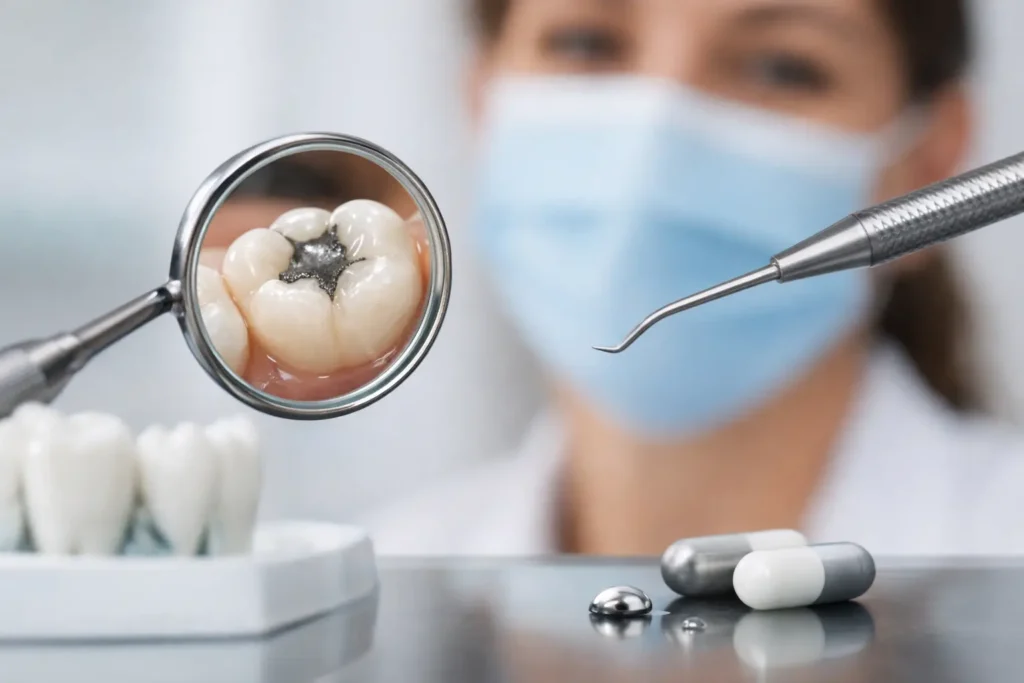
A silver-colored filling can raise understandable questions, especially when you are thinking about your overall health as well as your teeth. Are mercury fillings safe? For most adults with intact amalgam fillings and no symptoms, major dental and public-health organizations generally do not recommend removal solely because the filling contains mercury. Still, amalgam is not the best choice for every person, and replacing an existing filling can be appropriate when there is damage, decay, sensitivity, or a health-related reason to choose another material.
The right decision is personal. It should consider the condition of the tooth, the size and age of the filling, your medical history, pregnancy status, and your comfort with the materials used in your mouth.
What are mercury fillings made of?
What many patients call mercury fillings are dental amalgam fillings. They are made by combining liquid elemental mercury with a powdered alloy that typically includes silver, tin, and copper. The result is a durable material that has been used in dentistry for well over a century.
Amalgam is often called a “silver filling,” although it contains mercury. Mercury binds with the other metals as the filling sets. Small amounts of mercury vapor can be released, particularly during chewing, teeth grinding, or removal. That fact is the source of much of the concern, but it does not automatically mean that every amalgam filling is dangerous or requires immediate treatment.
Are mercury fillings safe for most people?
Research and regulatory guidance have generally found that dental amalgam is safe for most people. For a healthy adult with stable fillings, the mercury exposure from amalgam is usually considered low. Removing a filling that is functioning well also has downsides: the procedure can temporarily increase exposure to mercury vapor and particles, and it may require removing healthy tooth structure.
This is why a thoughtful dentist does not make a blanket recommendation to replace every amalgam filling. A filling should be evaluated as part of the whole tooth and the whole person. If there is no decay around it, no crack, no leakage, and no symptoms, monitoring may be the most conservative option.
That said, “safe for most people” is not the same as “ideal for everyone.” A wellness-centered approach makes room for both the established evidence and a patient’s individual circumstances, concerns, and treatment goals.
Who may need extra caution with amalgam?
The FDA advises certain groups to avoid receiving new dental amalgam fillings when possible and appropriate alternatives are available. These include pregnant people and those planning pregnancy, nursing mothers, children under age six, people with a known allergy or sensitivity to mercury or other amalgam components, and people with certain neurological diseases or impaired kidney function.
For these patients, a dentist may recommend composite resin, ceramic, glass ionomer, or another suitable restorative material. The best option depends on where the filling is located, how much tooth structure remains, bite forces, moisture control, and the risk of future decay.
If you have a medical condition, it is reasonable to discuss it with both your physician and dentist. The goal is not to create fear. It is to make material choices with a clear understanding of your health history.
When replacing a mercury filling makes sense
An amalgam filling may need replacement for the same practical reasons as any other filling. Over time, teeth and restorations experience pressure, temperature changes, and everyday wear. A filling that once fit well may eventually become compromised.
Replacement may be recommended when a filling is cracked, worn down, leaking, or associated with new decay. It may also be appropriate if the tooth has fractured, if there is persistent sensitivity or pain, or if the restoration is so large that the remaining tooth needs more protection than a filling can provide. In some cases, a crown or onlay is a better long-term solution.
Appearance can be a valid reason, too. Many patients prefer tooth-colored restorations rather than dark metal fillings, particularly in visible areas. A dentist should explain whether a cosmetic replacement is likely to preserve the tooth well and whether the benefits justify treatment.
Replacing a sound filling simply because it is old is not always necessary. Age alone does not tell us whether a restoration has failed. A clinical exam and X-rays, when appropriate, offer much more useful information.
Why the removal process matters
If you and your dentist decide to replace amalgam fillings, the way removal is performed matters. Drilling can release mercury-containing vapor and particles, so careful techniques are designed to reduce exposure for both the patient and dental team.
A cautious approach can include isolating the tooth with a dental dam, using high-volume suction close to the treatment area, providing ample water spray to keep the filling cool, and removing the amalgam in larger sections when possible instead of grinding it away. Protective barriers and effective room ventilation may also be part of the protocol.
At a practice trained in SMART mercury amalgam removal techniques, these protective measures are incorporated into a structured approach to removal. They do not make dentistry risk-free, but they reflect a commitment to reducing unnecessary exposure and supporting patient comfort.
Patients sometimes ask about supplements, detox programs, or medical testing before removal. These are not universally required. If you have significant health concerns, complicated medical conditions, or a history of reactions to dental materials, coordinating care with the appropriate medical professional may be helpful. Your dentist can also discuss what to expect after treatment, including temporary sensitivity and how the tooth will be restored.
Choosing a replacement material
Tooth-colored composite resin is a common alternative to amalgam. It bonds directly to the tooth and can often allow for a more conservative preparation, meaning less healthy tooth structure may need to be removed. It also blends naturally with surrounding enamel.
Composite is not automatically superior in every situation. Large fillings in heavy-biting areas can be challenging, especially for people who clench or grind their teeth. Moisture control during placement is essential, and some teeth are better protected with a ceramic onlay or crown. Ceramic restorations can be highly durable and natural-looking, but they involve a different preparation and are often more costly.
There is also no single “perfect” material for every patient. A health-conscious conversation should include the material’s expected longevity, aesthetics, strength, placement requirements, cost, and your personal sensitivities or preferences. Clear information helps you decide without pressure.
Questions to ask at your dental visit
If you are concerned about amalgam fillings, bring the question to your regular exam rather than relying on the color of the filling or its age. Ask whether the tooth shows signs of decay, cracks, leakage, or structural weakness. Ask whether monitoring is reasonable, what material is recommended if replacement is needed, and what protective steps will be used during removal.
It can also help to ask what happens if treatment is delayed. Some fillings can be watched safely; others may allow decay or cracks to progress beneath the surface. Knowing the reason behind a recommendation can make the decision feel more manageable.
For Houston patients seeking a whole-health perspective, the most reassuring plan is usually one that is both clinically sound and respectful of your concerns. You deserve an explanation of what is happening in your mouth, not a rushed decision.
A mercury filling is not automatically an emergency, and it is not a reason to ignore a tooth that needs attention. A careful exam can show whether keeping, monitoring, or replacing it is the healthiest next step for your smile and your peace of mind.